Autobiographical text written by Luigi Mancini for
“Le Marche, l’orto del vino”
by Andrea Zanfi, published in
2007 by Carlo Cambi Editore
The destiny of men is a curious thing. I wanted to design cars, and yet here I am, almost forty years old, talking about how I make wines and how I try to interpret the character of my land. It is not exactly the same line of work. I arrived at the estate at the end of 1995.
My father Ettore had decided to sell the villa in Fano and move into the house next to the winery. For him—at the time the only family member involved in running Fattoria Mancini—it would certainly have been a more convenient arrangement for managing the business. But for me, then an engineering student used to city life, the prospect of moving to the countryside was decidedly less exciting. I barely knew the winery and had almost no familiarity with the estate’s land, given that my father had always made sure to keep me away from that work environment—a world in which he himself, having interrupted his own engineering studies, had been forced to immerse himself, and I believe not very willingly.
The truth is that my studies had been progressing rather slowly for several years, not for lack of enthusiasm for the subject—quite the opposite. It was precisely my strong passion for mechanics, especially automotive mechanics, that led me to devote more attention to workshops and the pages of specialized magazines than to university classrooms and textbooks on mathematical analysis. After all, according to the good Italian academic tradition, the subjects taught had very little practical application, and I found it hard to appreciate such a way of teaching. When I was eleven, I had lived in London and attended an English school, where the Anglo-Saxon pragmatism allowed me to achieve far better academic results than I ever obtained back home. Here, I had never accepted that in hundreds of hours of lessons we had never once held a bolt in our hands! So I spent most of my time drawing cars, modifying engines, and reading manuals. Everything for which I had enrolled in the Faculty of Engineering was, in fact, distancing me from graduation.
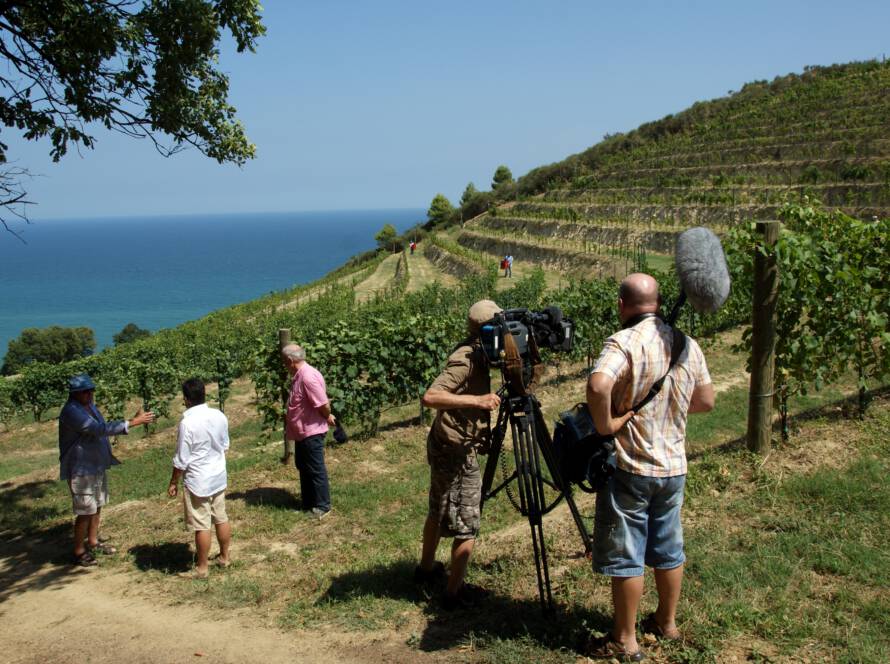
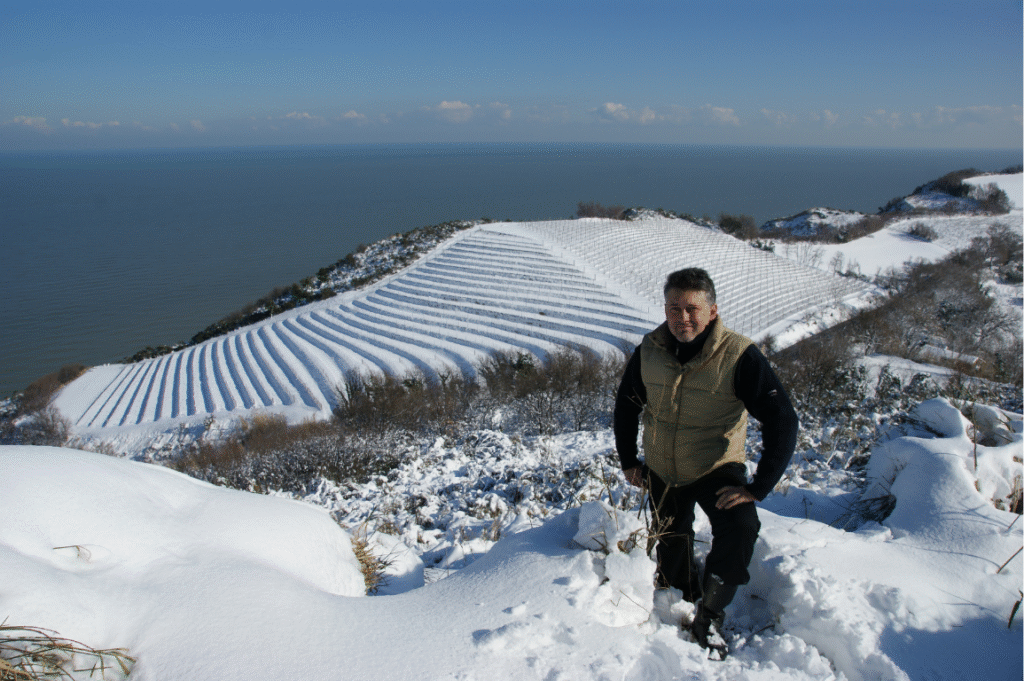
When we moved into the house on the estate, one of my first concerns was to find a space for my workshop and for my car. I found it in the corner of the winery farthest from the house: to get there, I had to walk through the entire building. And so I began to wonder how that world—one from which I had been cautiously kept away and about which I knew absolutely nothing—actually worked. One thing was clear, and on this I agreed with my father: the facility was no longer adequate for the times. A shame, because in the early seventies it had been designed as a rational and innovative winery. A few years earlier, my grandfather Luigi—also an engineer, like many Mancinis—had sold his construction company and, together with my father, had decided to invest in rebuilding the agricultural estate. They built the new winery—the family’s fourth since the mid-nineteenth century—and planted about forty hectares of new vineyards in Roncaglia and Focara, magnificent hills plunging into the sea just north of Pesaro. Then, for many years, things remained exactly as they were.
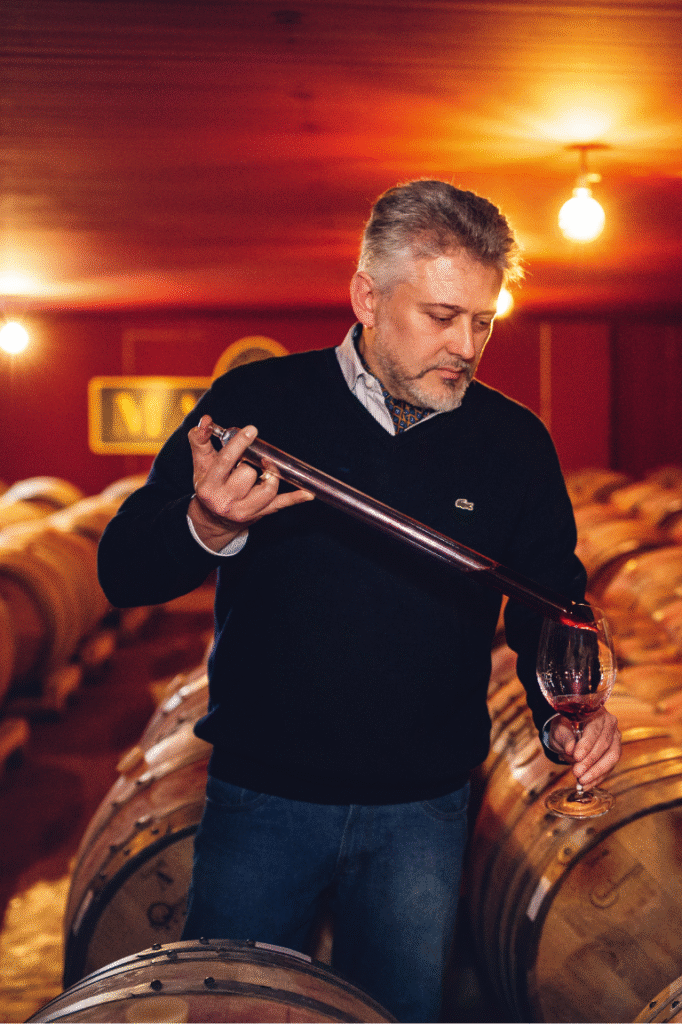

So I decided to lend a hand with the renovation, returning from university “…a day earlier…” on weekends. Before long, that “day earlier” became several days earlier, and when I realized that I was coming back from university to the estate on Tuesdays, I understood that the time had come to make a decision.
It was at that moment that I realized I had been irreversibly drawn into that winery. Often, coming home late, after parking my car, I would walk through the winery, pick up a chair and sit there for hours, trying to understand how everything worked and how it could be transformed to start a new chapter for the estate. I began to travel in search of anything useful I could learn elsewhere. First around Italy, then very often to France, and finally—inevitably—to those countries that grow Pinot Noir, our family grape: New Zealand, Oregon, California.
Within just a few years, the winery underwent a significant transformation. The rational structure created by my father and grandfather was a great help, while my passion for mechanics allowed me to tackle with enthusiasm the immense amount of study and work required for the technical overhaul. Soon after, with the same spirit with which I had worked in the winery, I began to take an interest in the vineyards, and I realized that new horizons were opening up—far more complex than anything I had encountered until then.
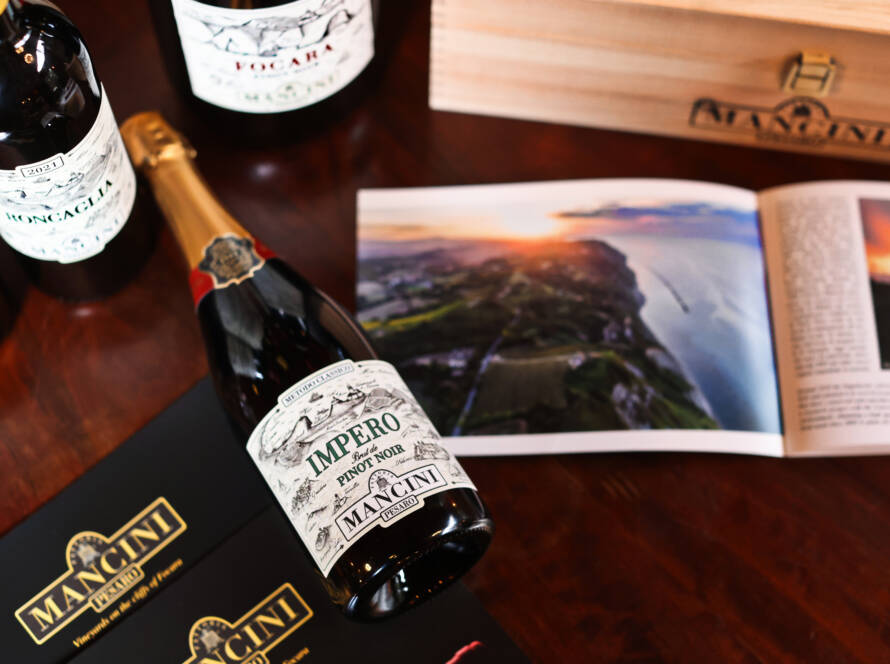
For decades, Fattoria Mancini had lived mainly on the sale of bulk wine to local customers, and despite the use of refined winemaking systems, bottled wine accounted for only a modest share of the company’s turnover. Yet it was precisely those early labels that formed the solid foundation of our current range. I also understood—when we decided to transform the business by focusing on bottled wine—that there were already wines in the estate worthy of development, and grape varieties on which we should concentrate. First among them was the Pinot Noir, so dear to my father and to his grandfather, introduced by the French administration during the Napoleonic rule and cultivated on our land for almost two centuries. It was not one of the usual international varieties; since 1870, when my great-great-grandfather Luigi purchased one of those vineyards from the French, that very Pinot Noir had been jealously preserved at Fattoria Mancini, and could by now rightfully be considered a native variety. Over almost two hundred years of adaptation to our soil and climate, it had acquired unique characteristics impossible to replicate elsewhere. In the wine one could find the varietal traits typical of Pinot Noir—something quite rare for a Pinot grown in central Italy.
After all, back then, whoever decided to plant Pinot Noir here on the Pesaro coast—while owning an Empire—must have had some good reason for doing so.
We decided to go beyond simple production and began, in collaboration with the University of Milan, a complex research project aimed at the clonal selection of the Focara Pinot Noir. Soon, the research expanded to include Albanella, a white grape variety found only in this area, endowed with highly distinctive and intriguing characteristics.
Research—in the broadest sense—quickly became a cornerstone of our corporate philosophy, a concrete expression of that desire to understand which has always characterized my way of living, and a constant incentive to refine every production process. In recent years, research has been the most inspiring tool for achieving, in wine, the expression of the character of my land and its grape varieties—always, and inevitably, interpreted in my own personal style, the same style I once hoped to give to my cars and which I now try to give to my bottles.